


I’ll be honest with you — I spent years thinking prime rib was one of those things you just ordered at a restaurant and never attempted at home. It seemed too expensive to risk screwing up, too intimidating to get right, and too much of a commitment for a weeknight. Then I came across the actual method Texas Roadhouse shared publicly, and it changed my entire approach. Not because it’s complicated, but because it’s surprisingly straightforward. The secret isn’t some exotic technique or hard-to-find ingredient. It’s patience, a killer marinade, and respecting the meat enough to let it do its thing.
Texas Roadhouse — which, fun fact, opened its first restaurant in Clarksville, Indiana, not Texas — has been serving prime rib since 1993. They now have locations in 49 out of 50 states, with 56 in Texas alone. Their steaks carry the USDA Choice label, are hand-cut by in-house butchers, and never frozen. The prime rib is marinated for at least 24 hours and slow roasted at around 300 degrees. Internally, the staff calls the roasts “logs,” and they cook different logs to different temperatures — some for rare and medium-rare orders, others for medium-well and well-done. You can even request an end cut for extra crust at no additional charge.
But here’s the thing: you don’t need a commercial kitchen or a specialized oven to pull this off. This copycat recipe uses the same principles and produces prime rib that’s pink, juicy, and falling apart under a butter knife. It just requires you to plan ahead — about two to three days ahead, to be specific.
Why the Two-Day Marinade Matters So Much
Most prime rib recipes hit you with a dry rub and send you straight to the oven. That works fine. But the Texas Roadhouse approach is different because the marinade does double duty — it seasons the meat deeply and breaks down the surface just enough to create that incredible crust when it hits high heat. The marinade ingredients are stuff you probably already have: kosher salt, minced garlic, liquid smoke, soy sauce, olive oil, sugar, and black pepper. That’s it. Nothing fancy. Nothing you need to order online.
You mix those together in a glass bowl three days before you plan to cook. Cover it and stick it in the fridge for 24 hours. Throughout that first day, give it a swirl or stir a few times to keep everything mingling. The soy sauce and salt start dissolving into each other, the garlic blooms, and the liquid smoke integrates instead of sitting on top like an afterthought. This matters. If you skip the overnight rest and just dump everything together and slap it on the meat, the flavors stay separated. You’ll taste salt in one bite, garlic in another. The overnight rest lets it become one thing.
On day two, you place the prime rib on a rack in a large pan — a glass casserole dish works well here — pour half the marinade over the top, and rub it all over. Flip it, pour the rest on, and rub that in too. Cover the whole thing tightly with cling wrap and put it back in the fridge for another full day. That’s when the magic happens. The marinade penetrates the meat slowly, and by cooking day, you’ve got flavor that goes deep instead of just sitting on the surface.
The Liquid Smoke Debate
Let’s talk about this because people have strong opinions. Liquid smoke is polarizing. Some home cooks consider it artificial or heavy-handed. Others swear by it. In this recipe, it’s the ingredient reviewers consistently point to as the secret behind the marinade’s flavor. It gives the finished prime rib that faint smokiness that makes people say, “Wait, did you grill this?” even though it came out of your oven.
Use just a teaspoon. Seriously. Liquid smoke is potent, and a little goes a long way. Wright’s Liquid Smoke is the brand you’ll find in most grocery stores — look near the BBQ sauce aisle. If you go overboard, the meat will taste like you cooked it inside a campfire. A single teaspoon mixed into the rest of the marinade gives you that subtle, “I can’t quite place it” smokiness without taking over.
Choosing and Prepping Your Roast
When you’re at the butcher counter — whether that’s Costco, Kroger, or your local meat shop — you want a bone-in ribeye roast, also called a standing rib roast. These are the same thing. Plan on about a pound of bone-in prime rib per guest, since each pound of raw meat yields roughly half a pound cooked. So for a dinner party of six, you’re looking at a 6-pound roast.
A full prime rib can weigh up to 16 pounds, but any good butcher will cut you a smaller piece. Ask them for a cut from the back — this tends to be more evenly shaped and cooks more consistently. Most supermarket prime rib is USDA Choice, which is perfectly good. USDA Prime has more fat marbling but costs about 50% more and usually requires a special order. For this recipe, Choice works great. The marinade adds so much flavor and moisture that you don’t need the extra marbling to get a tender result.
Cooking Day: The Method That Actually Works
This is where most people panic, and it’s also where most people make their biggest mistake: they pull the roast out of the fridge and throw it straight in the oven. Don’t do that. A cold, dense piece of meat in a hot oven is a recipe for an overcooked exterior and a raw center. Take the roast out of the refrigerator two full hours before cooking to let it come to room temperature. Yes, two hours. Set it on the counter and walk away.
When you’re ready, preheat the oven to 450°F. Slide the roast in and let it sear at that temperature for 30 minutes. This creates that brown, crispy crust on the outside — the bark, as Texas Roadhouse regulars call it. After 30 minutes, drop the oven to 250°F without opening the door. Continue cooking for approximately 2 hours.
Here’s the non-negotiable part: use a meat thermometer. Not the pop-up kind that comes stuck in a turkey. A real instant-read or leave-in probe thermometer. Stick it in the thickest part of the meat, away from the bone. You’re looking for 120°F for medium-rare. The temperature will climb about 4-5 degrees while the roast rests, so pulling it at 120°F lands you right at a perfect 125°F — rosy pink all the way through.
Resting Is Not Optional
After you pull the roast out, let it rest for at least 15 minutes. Some people recommend up to 30. I split the difference and go about 20 minutes, loosely tented with foil. This lets the juices redistribute throughout the meat. If you carve too soon, all those juices run out onto the cutting board and you’re left with dry, disappointing slices. Be patient. You’ve waited three days already — what’s another 20 minutes?
Don’t Skip the Au Jus
If you want the full restaurant experience, make an au jus while the meat rests. At the actual restaurant, prime rib comes with au jus, horseradish, or creamy horseradish on the side. For a simple version at home, take the drippings from the roasting pan and combine them with beef broth in a small saucepan. If you sliced the bones off before cooking (some people do to make carving easier), throw those in too along with a rough-chopped carrot, celery stalk, and half an onion. Simmer for about 90 minutes while the roast cooks, and the broth will reduce to about a quarter of its original volume. Strain it, season with salt and pepper, and you’ve got a sauce that ties the whole plate together.
Common Mistakes to Avoid
I’ve seen people mess this up a handful of ways, and they’re all avoidable. First, don’t use table salt instead of kosher salt. Texas Roadhouse says kosher salt is imperative, and they’re right. Table salt is much finer and saltier by volume — you’ll over-season the meat and wonder what went wrong. Diamond Crystal or Morton’s kosher salt is what you want.
Second, don’t open the oven door constantly to check on things. Every time you open it, you lose heat and extend your cooking time unpredictably. Get a thermometer with a probe that stays in the meat and reads from outside the oven.
Third, don’t cook to a clock. “Two hours at 250” is a guideline, not a rule. Ovens vary. Roast sizes vary. Ambient kitchen temperature varies. The thermometer is your only reliable guide. Cook to temperature, not time.
And finally, don’t serve this without sides that can stand up to it. Texas Roadhouse pairs prime rib with fresh-baked rolls and cinnamon butter, mashed potatoes, and bacon-seasoned green beans. Those rolls, by the way, are legendary for a reason — baked in-house and served with honey-cinnamon butter that people literally ask to take home. You don’t need to replicate all of it, but a starchy side and something green rounds out the plate nicely.
Is It Worth the Wait?
Absolutely, yes. The three-day process sounds daunting, but the actual hands-on work is maybe 20 minutes total. Mix a marinade. Rub it on the meat. Put it in the oven. That’s essentially it. The fridge and the oven do the heavy lifting. And the result — prime rib that’s so tender you might only need a butter knife, with a crust that shatters slightly when you cut into it and a center that’s perfectly, uniformly pink — is worth every minute of waiting. At a Texas Roadhouse, a 16-ounce serving runs about $29.49. You can make this at home for a fraction of that per person, and honestly, it’s just as good. Maybe better, because you did it yourself.
Frequently Asked Questions
Q: Can I use a USDA Choice roast instead of USDA Prime?
A: Yes, and you probably should unless money is no object. USDA Choice is what Texas Roadhouse actually uses, and it’s what you’ll find at most supermarkets. USDA Prime has more marbling but costs about 50% more and requires a special order from the butcher. The marinade in this recipe adds plenty of moisture and flavor, so Choice works perfectly.
Q: Can I cook this on a grill instead of in the oven?
A: You can. Use high direct heat to sear the outside for a few minutes per side, then move the roast to indirect heat and close the lid. Keep the grill around 250°F and cook the same way — to an internal temperature of 120°F for medium-rare. A meat thermometer is even more important on a grill since temperatures fluctuate more than in an oven.
Q: What if I don’t have three days to prep?
A: You can shorten the process by making the marinade in the morning and applying it to the meat that evening, then cooking the next day. You’ll still get good results, but the flavor won’t penetrate as deeply. Texas Roadhouse marinates for a minimum of 24 hours, and longer is better.
Q: How do I know when the prime rib is done without cutting into it?
A: A meat thermometer is the only reliable way. Insert it into the thickest part of the roast, away from the bone. Pull it at 120°F for medium-rare, 130°F for medium, or 140°F for medium-well. The internal temperature will rise another 4-5 degrees while the meat rests.
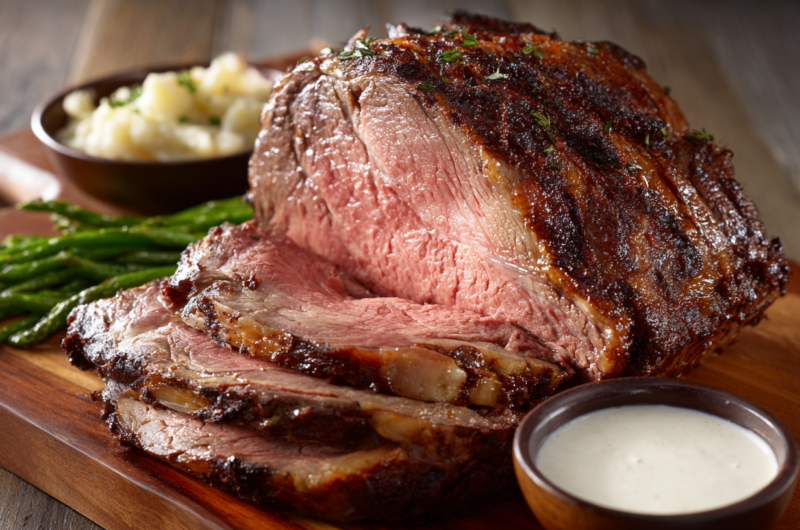
Texas Roadhouse Prime Rib (Copycat Recipe)
Course: DinnerCuisine: American6
servings20
minutes2
hours30
minutes650
kcalThe actual marinade and slow-roast method that makes Texas Roadhouse prime rib impossibly tender, now adapted for your home kitchen.
Ingredients
5-6 pound bone-in prime rib roast (standing rib roast)
2 tablespoons kosher salt
4 cloves garlic, minced
1 teaspoon liquid smoke
2 tablespoons soy sauce
2 tablespoons olive oil
1 tablespoon sugar
1 tablespoon freshly ground black pepper
1 teaspoon garlic powder
Directions
- Three days before cooking, combine kosher salt, minced garlic, liquid smoke, soy sauce, olive oil, sugar, black pepper, and garlic powder in a glass bowl. Stir well to combine. Cover with a lid or cling wrap and refrigerate for 24 hours, swirling or stirring the mixture several times throughout the day to let the flavors integrate.
- Two days before cooking, place the prime rib roast on a rack in a large roasting pan or glass casserole dish with sides. Pour half of the marinade over the top of the roast and rub it all over that side with your hands. Flip the roast and pour the remaining marinade over it, rubbing it into all surfaces.
- Cover the pan tightly with cling wrap and place it in the refrigerator. Let the roast marinate for a full 2 days. The salt and soy sauce will slowly work their way into the meat, seasoning it from the outside in.
- On cooking day, remove the roast from the refrigerator 2 hours before you plan to cook it. Let it sit on the counter, still in the pan, to come to room temperature. This step is critical — a cold roast will cook unevenly, leaving you with an overdone exterior and a raw center.
- Preheat your oven to 450°F. Place the roast in the oven and cook at this high temperature for 30 minutes. This initial blast of heat sears the outside and creates a brown, crispy crust — the bark that Texas Roadhouse fans love.
- After 30 minutes, reduce the oven temperature to 250°F without opening the door. Continue roasting for approximately 2 hours. Insert a meat thermometer into the thickest part of the roast, away from the bone, and cook until it reads 120°F for medium-rare.
- Remove the roast from the oven and tent it loosely with aluminum foil. Let it rest for 15 to 20 minutes. The internal temperature will continue to rise by 4-5 degrees during this time, and the juices will redistribute throughout the meat.
- Carve the roast by slicing between the bones if you left them on, or simply cutting even slices across the grain. Serve with au jus, prepared horseradish, or creamy horseradish sauce on the side, along with your choice of sides.
Notes
- Use kosher salt only — table salt is much finer and will over-season the meat. Diamond Crystal or Morton’s are both widely available and work well for this recipe.
- Cook to temperature, not time. The 2-hour estimate at 250°F is a guideline. Oven temperatures, roast sizes, and starting temperatures all vary, so rely on your meat thermometer for accuracy.
- For a simple au jus, simmer the pan drippings with 4 cups of beef broth, a rough-chopped carrot, celery stalk, and half an onion for about 90 minutes until reduced by three-quarters. Strain and season with salt and pepper before serving.