


Sunday lasagna is the easiest dinner in America to get right and the hardest to make anyone remember. The noodles go soft, the sauce goes red, the cheese melts into every corner of the pan, and by the third bite you already know exactly what the fourth one is going to taste like. The fix is not more mozzarella, and it is not a fancier sausage. It is a spice most people only pull out of the cabinet for coffee cake: cinnamon, stirred straight into the ricotta.
The Cinnamon Goes In The Cheese, Not The Sauce
Delish writer Judy Kim learned the trick from her Italian grandmother, who always worked ground cinnamon into the ricotta filling of her meat sauce lasagna. Kim’s family has never made it another way since, and she says the spice adds a “depth of flavor” that no other secret ingredient seems able to match. Her number is 1.5 teaspoons of ground cinnamon per batch of ricotta filling.
Cinnamon in a savory pan is less strange than it sounds. It is already doing quiet work in Moroccan lamb shanks and in a bowl of Cincinnati chili, where almost nobody tastes “cinnamon” so much as they taste something warm sitting underneath the meat. In a tray of lasagna it behaves the same way. The tomato stays tomato, the beef stays beef, and the cheese layer stops being the boring part of the bite.
How Much Before It Starts Tasting Like Dessert
A teaspoon and a half goes into the entire bowl of ricotta, not into each layer. If you are nervous, start under that and work up next time. Taste the filling cold, with a spoon, before any of it touches a noodle. When you can name the spice by itself, you have gone past the point of the trick.
A pinch of sugar often rides along with it. Cooks who grew up with this stir cinnamon and a little sugar into a ricotta mixture that already has Parmesan, egg and salt in it, and one family makes it every Christmas, then debates whether grandma would have added a smidge more.
Keep it out of the red sauce. Spread through a simmering ragu, cinnamon has to fight acid, garlic and herbs for attention, and it loses. The ricotta is the part of the dish with nothing to say for itself, so that is where the spice earns its keep.
The Ricotta Layer Is The American Part Anyway
Lasagne alla Bolognese, the Emilia-Romagna original, contains no ricotta at all. It is sheets of fresh pasta, a slow-simmered meat ragu, bechamel, and Parmesan scattered between the layers. Ricotta is southern Italian territory, the cheese behind stuffed shells, manicotti and cannoli. Southern versions such as lasagna napoletana do use it, but the ricotta-heavy lasagna Americans grew up on is largely an Italian-American adaptation, built by immigrants who reached for a cheese that was affordable and easy to find.
That filling is typically ricotta mixed with egg and herbs, which makes it easy to spread and helps it hold its shape under heat. It is also mild to the point of blank. Ricotta takes on the character of whatever you season it with, which is why one spice can change a whole pan.
Strain The Ricotta Or The Pan Will Weep
Supermarket ricotta carries more water than it looks like it does, and that water has to go somewhere. Store-bought ricotta should be strained well, or the liquid pools at the bottom of the dish and the noodles slide around or fall apart when you serve. Scott Tacinelli and Angie Rito, who own Don Angie in New York City’s West Village and wrote the cookbook “Italian American: Red Sauce Classics and New Essentials,” like what ricotta’s small curds do for texture in an American-style lasagna, and they like it for nostalgic reasons, though they note the style “can be a bit heavy.”
Cottage cheese is the swap if straining sounds like one chore too many. It holds together better, needs no draining, and gives you a similar tangy bite. The cinnamon disappears into it exactly the same way.
Nutmeg Is Cinnamon’s Quieter Cousin
Italian cooks have been putting warm spice in creamy fillings for a very long time. Nutmeg turns up constantly in bechamel and in the stuffing for tortellini and ravioli, and it works in a ricotta mixture for the same reason cinnamon does: the cheese is a chameleon. Jarred ground nutmeg is fine in a pinch, but a whole seed grated on a microplane hits harder, so use less of the fresh and more of the dried.
Plenty of cooks skip the ricotta entirely and build the dish on a bechamel seasoned with a pinch of nutmeg, which is how it is done in northern Italy. A standard proportion there is 1/8 teaspoon of ground nutmeg in a sauce built on 2 cups of milk. For the ricotta version on your table tonight, cinnamon leads and nutmeg is the understudy. If you want both, keep the nutmeg to a grating or two.
The Rest Of The Pan Still Has To Be Right
Reduce the meat sauce further than feels necessary. Spoon a little onto a flat plate: it should mound slightly and hold a clean edge instead of running. A loose ragu is the main reason a lasagna collapses into soup, and no amount of careful layering later will save it.
You can skip the boiling pot altogether. Lay the dry noodles flat in the empty 13×9-inch baking dish, cover them completely with very hot tap water, and let them soak about 20 minutes, then drain and pat them dry. They come out pliable and slightly underdone, close to fresh pasta, and they finish absorbing liquid in the oven. Sheets that are fully cooked before assembly turn to mush. Brand matters more than people admit here; De Cecco and Rummo are the dried pastas worth paying for. No-boil sheets are a legitimate shortcut too, and a 9-ounce box of Barilla covers three layers of pasta with no soaking at all.
Season every component, not just the sauce. Bland noodles and an unsalted cheese layer are two of the easiest mistakes to make, and both are invisible until it is on the plate. Then let the finished pan rest before you cut it. Slicing into lasagna straight out of the oven is how a perfectly good dinner ends up as a puddle.
Build It Today, Bake It Tomorrow
The meat sauce can be made up to two days ahead and refrigerated in an airtight container; it tastes better for the wait. The whole pan can be assembled up to one day before baking, then left at room temperature for 30 minutes and baked uncovered. Baked or unbaked, lasagna freezes well for up to three months, and leftovers come back best in a 325 degree Fahrenheit oven rather than the microwave.
Make the same recipe twice, once with the cinnamon and once without, and the plain pan tastes like something was left out. Nobody at the table will guess what it is, which is the entire point.
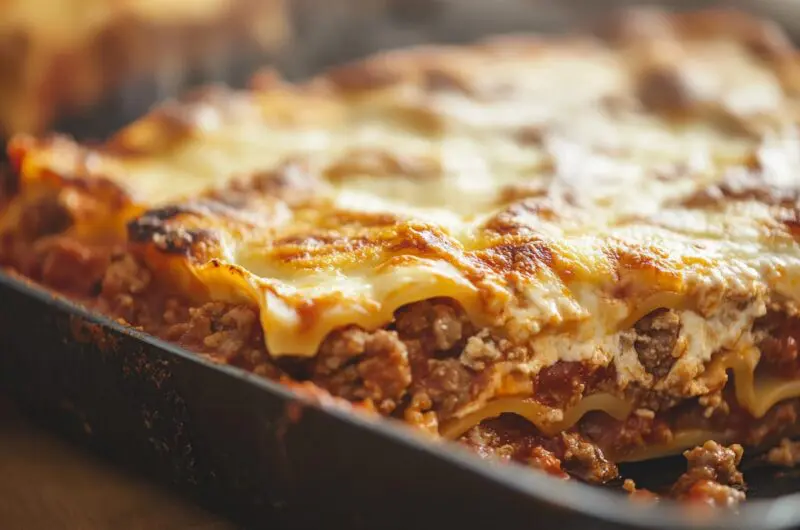
Cinnamon Ricotta Lasagna
Course: DinnerCuisine: Italian-American8
servings35
minutes1
hour30
minutes520
kcalThe Sunday lasagna with a baking spice hidden in the cheese layer that nobody can identify but everybody notices.
Ingredients
1 pound lean ground beef
1 medium yellow onion, finely diced, plus 3 cloves garlic, minced
2 tablespoons tomato paste
1 (28-ounce) can crushed tomatoes and 1 (15-ounce) can tomato sauce
32 ounces whole-milk ricotta, strained
1 1/2 teaspoons ground cinnamon, plus a pinch of granulated sugar
1 large egg and 1 cup grated Parmesan cheese, divided
1 pound fresh mozzarella, torn into pieces
15 dried lasagna noodles (most of a 1-pound box), kosher salt and black pepper
Directions
- Cook the onion and garlic in a little olive oil in a heavy-bottomed pot over medium heat until softened, 5 to 8 minutes. Add the ground beef, season with 1 teaspoon kosher salt and 1/4 teaspoon black pepper, and cook, breaking up the meat, until it is cooked through, about 5 to 6 minutes.
- Stir in the tomato paste and cook 2 to 3 minutes, until it darkens in color. Add the crushed tomatoes and tomato sauce, bring to a simmer, and cook gently for at least 30 minutes, until a spoonful mounds on a plate instead of running. Taste and add more salt as needed.
- While the sauce simmers, lay the dry noodles flat in an empty 13×9-inch baking dish and cover them completely with very hot tap water. Soak about 20 minutes, until pliable but still slightly firm, then drain, pat dry on a towel, and wipe out the dish.
- Set the ricotta in a fine-mesh strainer over a bowl for 20 to 30 minutes to drain off excess liquid, or press it between layers of paper towels. Skipping this is the fastest way to a watery pan.
- Stir the strained ricotta together with the egg, 3/4 cup of the Parmesan, the cinnamon, the pinch of sugar and 1/2 teaspoon kosher salt until smooth. Taste it cold with a spoon. You should get warmth and a little sweetness, not an identifiable hit of cinnamon.
- Heat the oven to 375 degrees Fahrenheit. Spread a thin layer of meat sauce across the bottom of the baking dish, then build in this order: noodles, ricotta filling, mozzarella, sauce. Repeat for three full layers, keeping the ricotta thin and even rather than in heavy dollops.
- Finish with a last layer of noodles, the remaining sauce, the rest of the mozzarella and the remaining 1/4 cup Parmesan. Cover tightly with foil, tenting it so it does not touch the cheese, and bake 40 minutes.
- Remove the foil and bake another 15 to 20 minutes, until the top is browned in spots and the edges are bubbling. Let the pan rest on the counter 20 to 30 minutes before cutting so the layers set and hold their shape on the plate.
Notes
- Taste the ricotta filling before you layer it. If you can name the cinnamon on its own, pull back next time.
- Cottage cheese swaps in for the ricotta one for one, holds together better and needs no straining.
- The sauce keeps two days in the fridge, the assembled pan one day (sit it out 30 minutes, then bake uncovered), and the lasagna freezes up to three months.
Frequently Asked Questions
Q: Will my lasagna actually taste like cinnamon?
A: Not at 1.5 teaspoons for a full batch of ricotta filling. It reads as warmth sitting under the meat and tomato, the same way cinnamon works in Cincinnati chili. Taste the filling before it goes in the pan and dial it back if the spice stands out on its own.
Q: Should I put the cinnamon in the meat sauce instead?
A: No. In the ragu it has to compete with acid, garlic and herbs. The ricotta is mild enough to take on whatever you season it with, so that is where the spice does its work.
Q: Can I use nutmeg instead?
A: Yes. Nutmeg does a similar job in a cheese filling, and Italian cooking already uses it in bechamel and in tortellini and ravioli stuffings. Freshly grated nutmeg on a microplane is more potent than the jarred ground kind, so use less of the fresh and more of the dried.
Q: Can I make the whole thing ahead of time?
A: The meat sauce holds two days in the refrigerator, and the pan can be fully assembled one day before baking. Let it sit at room temperature for 30 minutes, then bake uncovered. Baked or unbaked, it freezes for up to three months, and leftovers reheat best at 325 degrees Fahrenheit.