


The bread basket hits the table before anyone has opened a menu, and it is usually empty before the drinks arrive. Texas Roadhouse rolls are small, square, almost embarrassingly soft, and sweet in a way no other free steakhouse bread is. People have guessed at that sweetness for more than thirty years. Brown sugar? Condensed milk? Something proprietary shipped in from headquarters? It is honey, and far more of it than anyone puts in a normal dinner roll: half a cup in a batch of two dozen, plus a brush of melted butter the second they leave the oven.
Honey Is Doing Two Jobs
Founder Kent Taylor nearly went with free popcorn when the first location opened in Clarksville, Indiana, in 1993. He decided nothing pulls a dining room in like the smell of baking bread, then he and his kitchen manager worked through every flour and yeast they could get their hands on until they found a pairing that behaved. He wanted the sweetness of a Southern hot roll, but plain sugar adds little flavor of its own. Honey brings the sweetness and the flavor at once.
It also keeps the rolls soft. Honey is hygroscopic, meaning it pulls in moisture and holds onto it, so a honey-sweetened roll stays tender the next morning while a sugar-only roll has already gone dusty. That is why cutting the honey down to a tablespoon, which people do because half a cup looks like a typo, gives you a perfectly nice roll that tastes nothing like the restaurant’s.
What The Restaurant Does That Your Kitchen Can’t
Texas Roadhouse says its rolls are baked fresh every five minutes, across more than 750 restaurants in the United States and abroad. Some locations reportedly go through up to 10,000 rolls a day. One self-described employee on Reddit describes the dough starting life as a dry mix blended with yeast, sugar and water into a 50-pound ball, then rolled into a sheet and cut by hand, roll by roll.
The scale is the real wall. A commercial dough mix proofed and baked in batches all day is not something you replicate with a packet from the baking aisle. Accept that and the project gets easier. You are not cloning the roll. You are getting close enough that someone walking in the door asks what restaurant the bag is from.
Use Two Flours, Not One
The version below uses 2 1/2 cups of bread flour and 3 cups of all-purpose, and that split is deliberate. Bread flour builds structure and a little chew, which is what keeps the roll from collapsing into a sweet square of cotton. All-purpose keeps the middle soft. Together you get a roll that pulls apart in sheets instead of crumbling, which is exactly how the restaurant’s rolls behave when you tear one open.
Use instant yeast here, sometimes sold as quick rise or rapid rise. It goes in dry with the flour and skips the blooming step entirely. Active dry yeast works if that is what is in the cabinet, but it needs to be dissolved in warm liquid first and given time to foam.
They Have To Be Square
Shape is half the recognition. Texas Roadhouse rolls are squares and rectangles, not balls, which means you roll the risen dough into one big slab about half an inch thick and cut it with a pizza wheel or a dough blade. Twenty-four pieces from a batch. A kitchen scale is overkill; a ruler’s worth of eyeballing is fine, as long as the pieces are close in size so they bake evenly.
For noticeably flakier layers, some bakers roll the dough out, fold it in half, press the seam gently, then roll again before cutting. It takes an extra minute and gives you that pull-apart seam down the middle. Skip it if you want, the rolls are still excellent.
Space the squares about an inch and a half apart on buttered sheet pans. Butter the pans, do not line them with parchment, if you want the browner bottoms the restaurant gets.
Where Home Bakers Blow It
Leaving out the water is a real failure mode, not a hypothetical one. Stephie of Stephie Cooks, whose recipe this version follows, spent four attempts over a week producing bad rolls before realizing she kept forgetting the 1 1/4 cups of water that goes in the saucepan with the milk, honey and butter. Read the liquid list twice.
Heat matters more than anything else you control. With instant yeast you warm the liquids just until they feel warm to the touch; the butter does not need to melt completely. If you are using active dry instead, the liquid needs to sit between 110 and 115 degrees. Hotter than that kills the yeast and you will not know until an hour has gone by with nothing happening.
Knead for the full 5 to 8 minutes, but stop when the dough is smooth and elastic. Over-kneading an enriched dough like this one builds more gluten than you want and turns a tender roll chewy and tough.
Go by the dough, not the clock. Press a finger into it: if the dent springs back slowly, it is ready. If it does not spring back at all, give it more time. If it snaps back instantly, it needs longer still. Enriched doughs with eggs, milk, butter and honey rise slower than lean ones, so budget about an hour for the first rise and 30 minutes for the second even with fast-acting yeast.
Pull them at golden, not dark golden. Fifteen to eighteen minutes at 350 degrees is the window, and the butter brush has to happen the moment they come out. That brush is not decoration; it locks moisture into the crust and is the difference between a roll that is soft tomorrow and one that is not.
The Cinnamon Honey Butter Is Half The Recipe
Four ingredients, five minutes, and it carries as much of the experience as the bread does. Beat 1/2 cup of room-temperature butter with 1/4 cup honey, 1/4 cup powdered sugar and 1 teaspoon ground cinnamon until smooth, then add a pinch of salt and beat again. Equal parts honey and powdered sugar is the balance worth copying.
Powdered sugar is not optional, and bakers who have tried the all-honey version keep coming back to it. Without the sugar the butter goes thin and the texture never lands right. The butter must be softened, never melted, or it whips up dense instead of light and sets hard in the fridge. A splash of vanilla deepens it if you want to go further, and salted butter is perfectly fine; a little salt makes the honey read sweeter.
It keeps on the counter for a couple of days, in the fridge for up to two weeks, and freezes for three months if you roll it into a log and wrap it well. Let refrigerated butter sit out about 20 minutes before serving or it will tear the rolls apart.
Leftovers, If There Are Any
Stored airtight at room temperature, the rolls hold for four to five days. Warm them in a 350 degree oven for five or six minutes and they come back almost all the way. Baked rolls freeze for up to two months; thaw overnight in the fridge before reheating them. You can also freeze the cut squares before the second rise, then thaw, let them puff, and bake.
They are good well beyond the steak dinner they are meant for. Slider buns, pulled pork sandwiches, soup mopping, breakfast with jam. But the first batch should be eaten warm, standing at the counter, with the cinnamon honey butter melting straight through. That is the version that makes the restaurant’s rolls famous, and it is the version you can have at home for the price of flour.
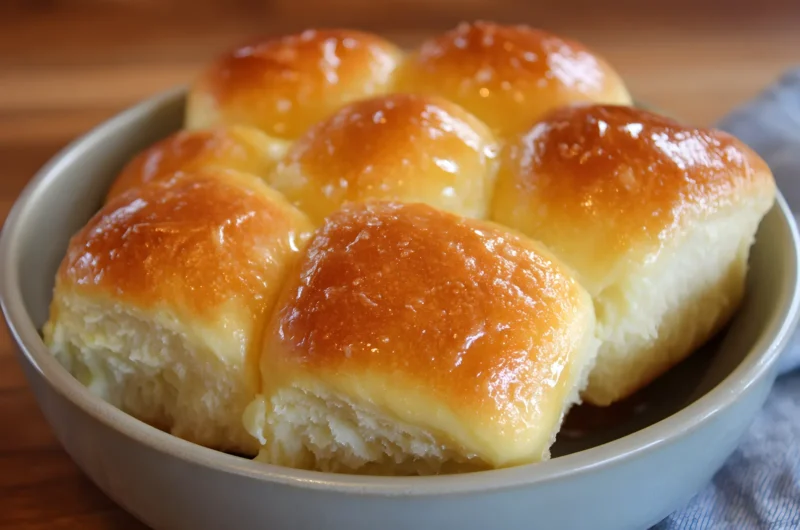
Copycat Texas Roadhouse Rolls
Course: BreadCuisine: American24
rolls30
minutes18
minutesSoft, sweet, square dinner rolls loaded with honey and brushed with butter straight out of the oven.
Ingredients
2 1/2 cups bread flour
4 1/2 teaspoons instant yeast (2 envelopes)
1 1/4 cups water
1/2 cup milk
1/2 cup honey
1/3 cup unsalted butter
1 1/2 teaspoons fine sea salt
2 large eggs
3 cups all-purpose flour
2 tablespoons salted butter, melted, for brushing (optional)
Directions
- Whisk 2 cups of the bread flour with the instant yeast in the bowl of a stand mixer. Keeping the yeast dry and mixed into the flour means you can skip blooming it entirely.
- Add the water, milk, honey and unsalted butter to a saucepan and heat over medium just until the mixture is warm. Do not let it get hot, and do not worry if the butter has not melted all the way.
- Fit the mixer with the dough hook, run it on low, and pour the warm liquid into the flour. Mix for 2 minutes, until everything is well combined and smooth.
- Add the remaining bread flour, the salt and the eggs. Mix on low until combined, then raise the speed to medium and add the all-purpose flour one cup at a time until the dough pulls away from the sides of the bowl.
- Turn the dough out onto a well-floured counter and knead for 5 to 8 minutes, until it is smooth and elastic. Push with the heel of one hand, fold the dough back over itself, turn it 90 degrees and repeat.
- Put the dough in a lightly greased bowl, cover it with a clean tea towel, and let it rise somewhere warm for about an hour, until doubled. Press a finger into it to check: the dent should spring back slowly.
- Turn the dough gently onto a lightly floured surface and roll it into a large rectangle about 1/2 inch thick. Cut it into 24 squares with a pizza cutter or dough blade and set them on buttered baking sheets about 1 1/2 inches apart.
- Let the squares rise 30 minutes, until puffy, and preheat the oven to 350 degrees F while they do. Bake 15 to 18 minutes, until golden, and brush the tops with the melted salted butter the second they come out. Serve warm with cinnamon honey butter.
Notes
- For the cinnamon honey butter, beat 1/2 cup room-temperature butter with 1/4 cup honey, 1/4 cup powdered sugar and 1 teaspoon ground cinnamon until smooth, then add a pinch of salt and beat again. Use softened butter, never melted.
- For flakier, more pull-apart layers, roll the dough into a rectangle, fold it in half and press the seam gently, then roll it out again before cutting the squares.
- Rising times are a guideline, not a rule. Go by the dough: doubled in size for the first rise, visibly puffy for the second.
Frequently Asked Questions
Q: Can I use active dry yeast instead of instant?
A: Yes, but the method changes. Dissolve it in warm liquid between 110 and 115 degrees F with a little of the sweetener and wait about 5 minutes for it to foam before you build the dough. If it never foams, the yeast is dead and the rolls will not rise, so start over with a fresh packet.
Q: What if I only have all-purpose flour?
A: You can make the rolls with all-purpose throughout. Bread flour is what gives the squares a bit of structure and chew, so an all-purpose batch comes out softer and more delicate. They still taste like the restaurant’s, because the honey is doing the heavy lifting.
Q: My dough is sticky and will not pull away from the bowl. What now?
A: Add flour a tablespoon at a time until the dough clings to your finger for a moment and then releases. Tacky is correct; sticky is not. Resist dumping in half a cup at once, because too much flour is what turns a tender roll dry.
Q: Can I freeze these?
A: Baked rolls keep in the freezer for up to two months. Wrap them in foil, seal them in a freezer bag, and thaw overnight in the refrigerator before warming them in a 350 degree oven for five or six minutes. You can also freeze the cut squares before the second rise, then thaw, let them puff and bake as usual.