


Saturday morning, bread in the toaster, butter going shiny in the skillet. You crack the eggs, stir them around, and somewhere in the middle of all that you shake salt over the top. That pinch lands too late to do the eggs much good. Salt belongs in the bowl with the raw eggs, whisked in and left alone for about 15 minutes before the pan ever gets warm.
Salt In The Pan Shows Up Too Late To Help
An egg white is mostly protein floating in water. Heat makes those proteins grab onto each other, and the tighter they grab, the more water gets squeezed out. That is the whole story behind a plate of eggs that is somehow dry and weeping at the same time.
America’s Test Kitchen recommends salting raw eggs before scrambling, on the grounds that “salt dissolves egg proteins so that they’re unable to bond as tightly when cooked.” Looser bonds mean the water stays put. The eggs stay tender instead of turning into little rubber pellets.
There is an electrical side to it too. Egg proteins carry a negative charge that normally keeps them apart, and salt neutralizes that charge enough for the proteins to link up gently rather than clamping down. In a hot skillet, egg proteins can bind so tightly they wring out their own moisture.
None of that can happen in the few minutes your eggs spend setting over a burner. Salt sprinkled onto curds that are already forming sits on the surface, seasons unevenly, and does nothing for texture. You get one salty bite and three bland ones.
But Gordon Ramsay Says Wait, So Who Is Right
The most famous scrambled egg technique on the internet does the exact opposite. During a demonstration on Season 8, Episode 5 of “MasterChef,” Gordon Ramsay told the cooks to hold the seasoning, warning that “if we were to season the eggs now, they would go grey.” He seasons at the very end, off the heat.
His full method is worth knowing: eggs cracked into a cold pan with butter, never whisked, stirred constantly while the pan moves on and off the burner every 30 seconds or so, then finished with crème fraîche and chives. Salt and pepper go in with the crème fraîche at the end.
Both camps are describing the same chemistry from different ends. Salt does pull water out of raw eggs. Given 15 minutes in the bowl, it hands that water back by building a protein network that holds onto it. Given no time at all, it simply seasons the eggs, and in side-by-side testing they come out nearly the same.
J. Kenji López-Alt, the MIT graduate who wrote The Food Lab: Better Home Cooking Through Science, lands firmly on the early side. He advises beating eggs with salt 15 minutes before cooking, because salt dissolves the proteins and lets them form a moisture-binding network before heat ever gets a chance to tighten them up. He has taken on Ramsay’s never-salt-early rule directly in his New York Times column.
Honest caveat: Daniel Gritzer of Serious Eats ran the test, salting eggs an hour, 30 minutes, 15 minutes, 5 minutes and 0 minutes before cooking, and found the batches “nearly indistinguishable,” with the longest-salted eggs only slightly more tender. So this is not a miracle. It is a free improvement that costs you nothing but the order you do two steps in, and it guarantees even seasoning either way. That alone settles it for me.
What Happens During The 15 Minutes
Whisk the salt in, then look at the bowl. Raw whites are ropy and streaky, and after a rest the mixture smooths out into a deeper, more even yellow that pours in one steady stream instead of clumps and liquid. That change is your signal the salt has gone to work on the proteins.
The wait costs you nothing because you are already busy. Fifteen minutes is a pot of coffee, a couple of slices of toast, bacon in a second pan, or the time it takes to set the table. Salt the eggs first thing when you walk into the kitchen and the rest of breakfast fills the gap on its own.
There is no penalty for going longer. Thirty minutes, an hour, it all cooks the same. What you cannot do is rush the eggs into a hot pan, because heat, not salt timing, is what turns eggs rubbery.
Low And Slow, Then Off The Heat Early
Pre-salted eggs reward a gentle pan. High heat produces large, puffy curds, while low heat with constant stirring gives you small, tender curds and something close to custard. A double boiler is ideal if you own one, but a nonstick skillet or a small saucepan set on low does the job.
Keep the spatula moving and scrape the bottom and the sides, not just the middle. If the curds start setting faster than you can stir, lift the pan off the burner for 15 or 20 seconds and keep stirring, then put it back. Pull the eggs while they still look a little underdone, because they go on cooking on the plate.
A spoonful of cold dairy off the heat is the best insurance in the whole process. Ramsay uses crème fraîche and has said the cold dairy cools the eggs down and stops the cooking, and sour cream does the same job. A knob of cold butter works the same way. Skip milk, which thins the eggs out. Two eggs is one normal portion, three if you are hungry.
The Mistakes That Undo All Of It
Cranking the burner is the big one. Fast, hot cooking squeezes the proteins together and pushes water out, and no amount of clever salting saves eggs from a screaming pan. If you can hear sizzling when the eggs go in, the heat is too high.
Overwhisking is the second. You want the yolks and whites combined, not aerated into foam, so 20 seconds with a fork is plenty. Ramsay goes further and never whisks at all, cracking the eggs straight into the pan.
Oversalting sneaks up on people once the salt is dissolved and evenly spread, since the whole batch tastes seasoned instead of just the top. Start with half a teaspoon of kosher salt for six eggs and adjust from there. Table salt packs tighter in the spoon, so use a lighter hand with it.
Pepper is worth adding at the same time or right at the end, your call. The egg producer Sauder’s Eggs makes the case for using both, since salt “suppresses bitter tastes” while pepper brings a little heat.
Where To Take Them Once You Nail It
Swapping in a different salt is the easiest upgrade, because everything you whisk in gets distributed through every bite. Smoked salt gives the eggs a bacon-adjacent edge without any bacon, and herb or spice blends season the whole batch instead of sitting on top.
Thick sourdough toast is still the best landing pad, toasted while the eggs cook so nothing sits around. A ham croissant sandwich is an excellent lunch use, and the custardy texture of pre-salted eggs is soft enough that a drizzle of maple syrup is not the strange idea it sounds like. Mushrooms and blistered vine tomatoes on the side turn it into a real plate.
Move the salt shaker off the stove and onto the counter next to the mixing bowl. That is the entire change, and it is the difference between eggs you tolerate and eggs you want again tomorrow.
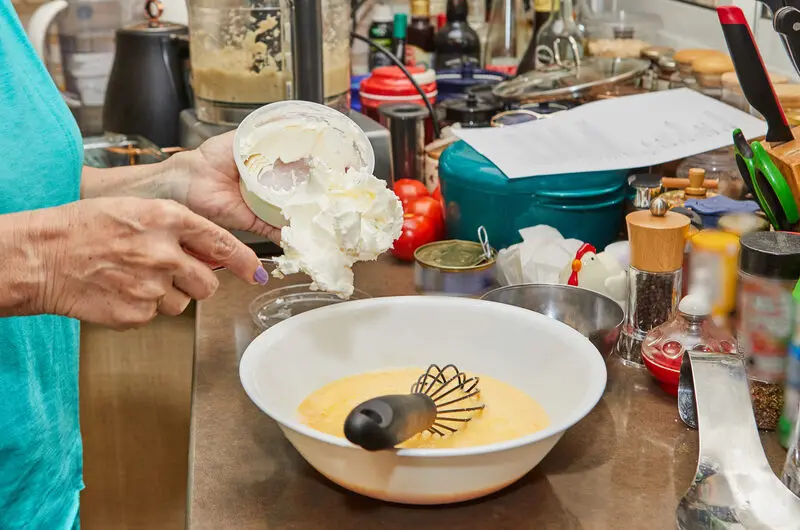
Pre-Salted Soft Scrambled Eggs
Course: BreakfastCuisine: American3
servings18
minutes7
minutes320
kcalThe 15-minute salt trick that turns ordinary eggs into creamy, custardy curds every single time.
Ingredients
6 large eggs
1/2 teaspoon kosher salt
2 tablespoons cold unsalted butter, cut into small cubes
1 tablespoon cold sour cream or creme fraiche
Freshly ground black pepper, to taste
1 tablespoon snipped fresh chives
3 thick slices sourdough bread
Butter for the toast
Flaky or smoked finishing salt, optional
Directions
- Crack the eggs into a medium bowl and beat with a fork for about 20 seconds, just until the yolks and whites come together. Stop well before the mixture turns foamy, since air bubbles give you a tight, spongy scramble instead of soft curds.
- Add the kosher salt and whisk for another 5 seconds to spread it through. Set the bowl on the counter and leave it alone for 15 minutes.
- Use that time for the rest of breakfast. Start the coffee, cook bacon, slice the bread, set the table. When you come back, the eggs should look smoother and a deeper, more even yellow than they did when you whisked them.
- Set a nonstick skillet or small heavy saucepan over low heat and add half the butter cubes. Let them melt slowly without browning or foaming hard. If the butter sizzles loudly, the heat is too high, so pull the pan off and let it cool for a minute.
- Pour in the eggs and start stirring immediately with a silicone spatula, sweeping the bottom and the sides of the pan the whole time. Keep the motion slow and constant rather than beating the eggs around.
- Any time the curds start setting faster than you can stir, lift the pan off the burner for 15 to 20 seconds and keep stirring, then set it back down. Expect soft, small curds to form over roughly 4 to 6 minutes on low heat.
- When the eggs are glossy and still look slightly underdone, stir in the remaining butter cubes. Take the pan off the heat entirely and fold in the cold sour cream or creme fraiche, which stops the cooking and adds richness.
- Grind in black pepper, fold in the chives, and pile the eggs onto buttered sourdough toast. Add a small pinch of flaky or smoked salt on top if you like, and serve right away, because the eggs keep setting on the plate.
Notes
- Longer than 15 minutes is fine. Salted eggs can sit covered in the fridge for up to an hour with no downside, so you can prep them before a crowd wakes up.
- Table salt is denser in the spoon than kosher salt, so start with about a third of a teaspoon for six eggs and taste at the end.
- Skip the milk. Cold sour cream, creme fraiche, plain yogurt or a knob of cold butter at the finish all cool the eggs and add body without thinning them out.
Frequently Asked Questions
Q: Does the 15-minute rest really change anything?
A: It gives the salt time to dissolve and loosen the egg proteins so they hold onto water during cooking. One side-by-side test found the difference between salting an hour ahead and salting right before cooking almost indistinguishable, so treat it as a small, free upgrade rather than a transformation. The guaranteed win is even seasoning in every bite.
Q: Why does Gordon Ramsay season at the end instead?
A: On “MasterChef,” he warned that eggs seasoned too early “would go grey,” and his method adds salt and pepper in the final seconds along with creme fraiche. Salt does pull water out of raw eggs at first. The rest in the bowl is what lets it hand that moisture back.
Q: Can I salt the eggs the night before?
A: Up to an hour ahead is well tested and works fine. Overnight is longer than any of the standard advice covers, so if you are prepping ahead, do it in the morning and let the coffee brew while the bowl rests.
Q: What heat level should I use for the creamiest eggs?
A: Low, with constant stirring. High heat builds large, puffy curds, while low heat and steady stirring gives small, tender curds with a custard-like texture. A double boiler is ideal, and pulling the pan off the burner for a few seconds at a time works just as well.