


I’ve been cooking seriously for about twenty years now. In that time, I’ve bookmarked hundreds of recipes, filled three notebooks with scribbles, and saved so many links on my phone that I had to make folders for my folders. But if my kitchen caught fire tomorrow and I could grab one thing on the way out (after the dog, obviously), it wouldn’t be a cookbook. It wouldn’t be my stand mixer. It would be a single index card, stained with butter and written in my grandmother’s handwriting, for her pecan fudge pie.
Not because it’s the fanciest thing I know how to make. Not because it would impress anyone on a cooking show. Because it’s the recipe that makes me feel like I’m ten years old again, sitting at her kitchen table, watching her work a double boiler like she was conducting an orchestra. That card is irreplaceable. Everything else I could Google.
Why This Pie, Out of Everything
Let me be honest. Pecan fudge pie is not a looker. It’s dark, dense, and kind of homely sitting on the counter. Nobody’s putting it on Instagram with a ring light. But the first bite is something else entirely. Rich, fudgy chocolate filling with pecans throughout, all inside a flaky butter crust. No baking required for the filling itself, which makes it feel almost like cheating, except the result is better than most things that take twice the effort.
My grandmother made this pie for every holiday, every birthday, every Sunday that she decided was special enough. The process was always the same. Double boiler on the stove. Butter and chocolate melting together slowly. Then eggs, sugar, and a pile of chopped pecans folded in until the whole thing turned into what she called “silk with crunch.” She poured it into a blind-baked pie crust, let it set in the fridge, and that was it. The recipe itself is deceptively simple, which is part of its genius.
What Makes a Recipe Worth Saving
Here’s the thing most people don’t think about until it’s too late. The recipes that matter most to us aren’t usually the complicated ones. They’re the ones that carry a story. A recipe becomes an heirloom when it tells you something about where you came from. Maybe it was first made during a hard winter. Maybe it showed up at every Thanksgiving for forty years. Maybe it was the only thing your great-aunt knew how to make well, and she made it with so much love that nobody cared it was the same dish every time.
The problem is that these recipes are fragile. They live on a single notebook page, on a stained index card, or worse, only in someone’s memory. Handwriting fades. Paper gets tossed during a move. Memories slip. And too many families find out too late that a cherished dish is just gone. Not because anyone meant to lose it, but because nobody thought to write it down, photograph it, or ask questions while the person who held it was still around.
The Science Behind Why This Pie Hits Different
I used to think my attachment to this pie was just sentimentality. Turns out there’s actual science behind it. The part of your brain that processes smell is directly connected to the areas responsible for emotion and memory. That means when you smell chocolate and butter melting together in a double boiler, your brain doesn’t just register “oh, that smells good.” It fires up specific memories connected to people and places. A 2025 study out of the University of Pittsburgh found that nearly every person interviewed described a deep emotional attachment to specific dishes from childhood, and that those foods made them feel safe, content, and connected in a way nothing else could match.
There’s even a name for the phenomenon where a single taste transports you back to a specific moment in time. It’s called the Proust effect, named after a French novelist who wrote about how biting into a small cake flooded him with childhood memories. That’s exactly what happens to me with this pie. One forkful and I’m back in my grandmother’s kitchen, feet not touching the floor, watching her stir chocolate in that old dented pot.
The Actual Recipe, And Why Every Step Matters
The beauty of pecan fudge pie is that you don’t need to be a skilled baker. You need patience with a double boiler, good chocolate, and real butter. That’s basically it. The filling comes together in about 15 minutes on the stovetop, and then the fridge does the rest of the work.
Start with a blind-baked pie crust. You can make your own or use a store-bought one from Pillsbury or whatever you prefer. I won’t judge. The filling is where the magic lives anyway. You melt a stick of butter with about 6 ounces of semi-sweet chocolate in a double boiler, stirring constantly until it’s completely smooth. Then you take it off the heat and whisk in eggs one at a time, followed by sugar and a splash of vanilla. Fold in a cup and a half of roughly chopped pecans, pour the whole thing into your cooled crust, and refrigerate for at least four hours. Overnight is better. The filling firms up into this incredibly dense, fudgy layer that’s somewhere between a truffle and a brownie, studded with pecans that give it just enough texture to keep things interesting.
Common Mistakes That Will Ruin It
The number one mistake people make is using the microwave instead of a double boiler. Yes, it’s slower. Yes, you have to stand there and stir. But the double boiler gives you gentle, even heat that keeps the chocolate from seizing or getting grainy. The microwave is unpredictable, and you’ll end up with lumps or, worse, scorched chocolate that tastes bitter. Just set up the double boiler and do it right.
Mistake number two is adding the eggs while the chocolate mixture is still too hot. If the mixture is screaming hot when those eggs go in, you’ll get scrambled egg bits in your filling. Let it cool for about five minutes after you take it off the heat. It should be warm but not hot enough to cook the eggs on contact.
Third mistake: not letting it set long enough. I know four hours feels like forever. I know the temptation to “just check if it’s ready” at the two-hour mark is real. Don’t do it. If you cut into it too early, the filling will be loose and soupy and you’ll think you did something wrong. You didn’t. You just need to be patient. Overnight in the fridge gives you the best texture.
Variations That Won’t Make Grandma Roll Over
The base recipe is sacred to me, but I’ve experimented over the years. A pinch of flaky sea salt (Maldon, if you can find it) on top right before serving does something wonderful. It cuts through the richness and makes the chocolate flavor pop. My cousin swaps half the pecans for walnuts, and while I think she’s wrong, I’ll admit it’s still good. You could also use dark chocolate instead of semi-sweet if you want something more intense, but don’t go above 70% cacao or it’ll be too bitter without adding more sugar.
One variation I do love: adding a tablespoon of bourbon to the filling. My grandmother would probably raise an eyebrow, but it works beautifully with the pecans and chocolate. Just whisk it in with the vanilla.
Save Your Recipe Before It’s Too Late
I got lucky. My grandmother wrote her recipe down on that index card, and my mom had the sense to put it in a plastic sleeve in a binder. But so many families aren’t that fortunate. The best advice I’ve ever gotten about preserving family recipes is simple: don’t cook with the original. Scan it, photograph it, save it to the cloud, and make copies. Use the copy in the kitchen. Keep the original somewhere safe.
But the even better advice? Don’t just save the recipe. Save the story. Write down who made it, when they made it, and what it meant to your family. Ask your relatives about it while you still can. Because fifty years from now, your grandkids won’t just want to know the ingredients and measurements. They’ll want to know who stood at the stove stirring the chocolate, and why it mattered enough to save.
That index card in my binder has a grease stain in the corner and a margin note that says “more pecans, always.” That note, in her handwriting, is worth more to me than any recipe I’ll ever find online. It’s a piece of her. And that’s why, if the kitchen caught fire, it’s the one thing I’d grab.
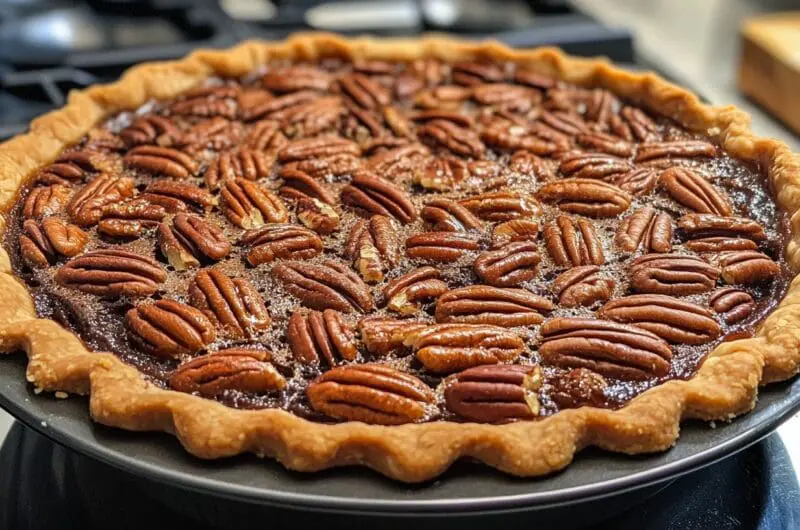
Grandma’s Pecan Fudge Pie
Course: DessertCuisine: American8
servings20
minutes15
minutes420
kcalA no-bake fudge filling with chopped pecans in a flaky crust. The kind of recipe worth saving in a fire.
Ingredients
1 pre-made pie crust (store-bought or homemade), blind-baked and cooled
1/2 cup (1 stick) unsalted butter
6 ounces semi-sweet chocolate chips or chopped chocolate
3 large eggs, room temperature
3/4 cup granulated sugar
1 teaspoon pure vanilla extract
1 1/2 cups roughly chopped pecans
1/4 teaspoon fine sea salt
Flaky sea salt for topping (optional)
Directions
- Set up a double boiler by placing a heatproof bowl over a pot with about an inch of simmering water. Make sure the bottom of the bowl doesn’t touch the water. Add the butter and chocolate to the bowl and stir constantly with a spatula or wooden spoon until completely melted and smooth, about 5 to 7 minutes.
- Remove the bowl from the heat and let it cool for about 5 minutes. You want it warm but not hot. If you stick your finger in (carefully), it should feel like warm bath water, not something that would cook an egg on contact.
- Whisk in the sugar and salt until fully combined and the mixture looks glossy. This will take about a minute of steady whisking. Don’t rush this step, as properly dissolving the sugar here gives you a smoother filling.
- Add the eggs one at a time, whisking well after each addition. Make sure each egg is fully incorporated before adding the next. The mixture will go from thick and dark to slightly lighter and silkier as you add the eggs.
- Stir in the vanilla extract. If you’re adding bourbon, add 1 tablespoon here as well. Mix until evenly distributed throughout the filling.
- Fold in the chopped pecans with a spatula until they’re evenly distributed. Don’t over-mix. You want the nuts spread throughout but you don’t want to deflate the filling. A few gentle folds should do it.
- Pour the filling into your cooled, blind-baked pie crust. Use the spatula to spread it evenly and smooth the top. Tap the pie gently on the counter a couple times to release any air bubbles trapped inside.
- Cover loosely with plastic wrap (don’t let it touch the surface of the filling) and refrigerate for at least 4 hours, though overnight is best. Before serving, sprinkle with flaky sea salt if desired. Slice with a sharp knife dipped in hot water for the cleanest cuts.
Notes
- Use a double boiler, not a microwave. The gentle heat prevents the chocolate from seizing or turning grainy, and it gives you much more control over the texture of the filling.
- Let the chocolate mixture cool for a full 5 minutes before adding eggs. If it’s too hot, you’ll get bits of cooked egg in your filling and there’s no fixing that.
- This pie tastes best on day two. The filling continues to set and the flavors deepen overnight, so make it the day before you plan to serve it if possible.
Frequently Asked Questions
Q: Can I use milk chocolate instead of semi-sweet?
A: You can, but the filling will be noticeably sweeter and won’t have the same depth. If you go with milk chocolate, reduce the sugar to 1/2 cup instead of 3/4 cup so it doesn’t become cloyingly sweet. Semi-sweet or a 60% dark chocolate gives the best balance with the pecans and butter.
Q: How do I blind-bake a pie crust if I’ve never done it?
A: Roll out your dough (or unroll your store-bought crust) into a 9-inch pie dish. Prick the bottom with a fork, line it with parchment paper, and fill with dried beans or pie weights. Bake at 375°F for about 15 minutes, remove the weights and parchment, then bake another 5 to 8 minutes until the crust is golden. Let it cool completely before adding the filling.
Q: How long does pecan fudge pie last in the fridge?
A: Covered well, it will keep for about 5 days in the refrigerator. The texture actually improves on days two and three as the filling gets even denser and more fudgy. It doesn’t freeze well because the filling can get a bit crumbly once thawed, so plan to eat it within the week (which has never been a problem in my house).
Q: What if I don’t have a double boiler?
A: You don’t need an actual double boiler. Just set a glass or metal mixing bowl over a saucepan with an inch or two of simmering water. The bowl should sit on top of the pan without the bottom touching the water. This works exactly the same way and costs you nothing extra. Most home cooks use this method and it works perfectly every time.